Restored Safety
Eliminate hanging hazards and unstable root plates that threaten family members and visitors.
Comprehensive post-storm tree clearing, canopy repairs, and insurance documentation in Thabeban.
Providing storm damage cleanup across Thabeban, Avenell Heights, Kepnock, and Norville.
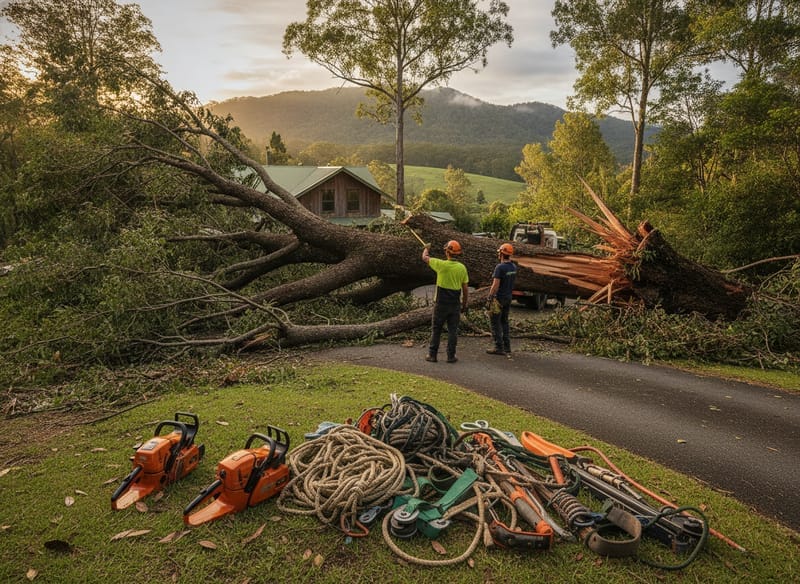
When summer storms, monsoons, or ex-tropical systems tear through the region, our storm damage tree removal Thabeban service delivers complete property cleanup and hazard mitigation.
Severe weather events in Thabeban frequently bring destructive wind gusts combined with torrential rainfall. This dual impact loosens root plates in the flat terrain and tears heavy branches from brittle Jacarandas and over-weighted Mangos.
Eliminate hanging hazards and unstable root plates that threaten family members and visitors.
Our clear, professional invoices and photos provide the necessary evidence for claim assessments.
Clean pruning cuts on storm-torn limbs prevent decay fungi from entering the main trunk.
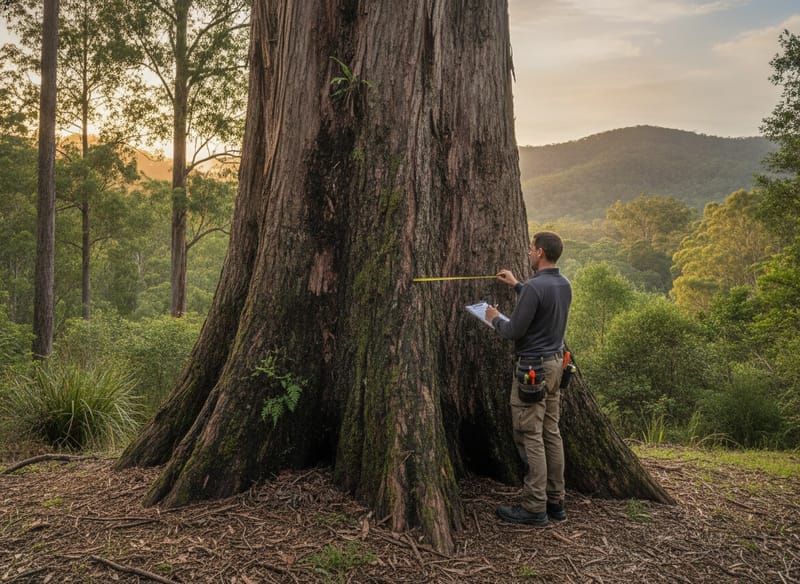
We inspect your Thabeban property to identify all fallen, cracked, and hanging storm timber.
We photograph the damage and prepare an itemised written quote suitable for insurance assessment.
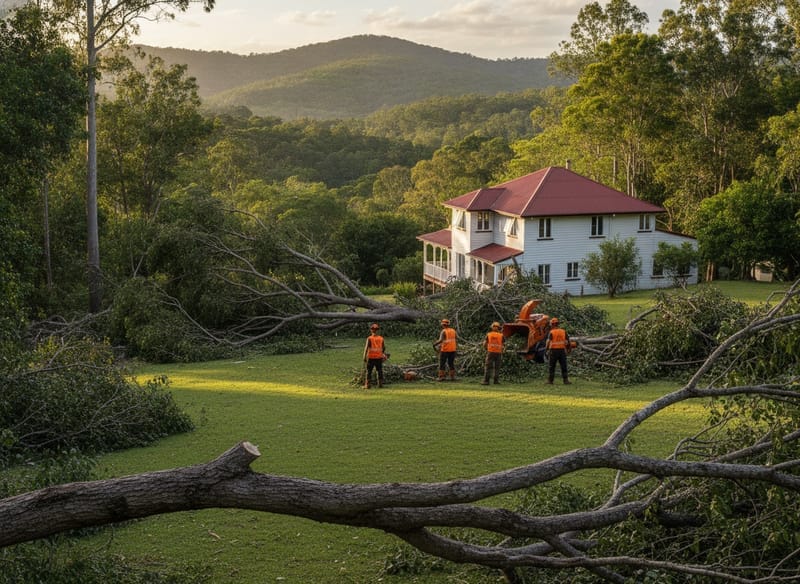
Our crew cuts up fallen trunks, extracts hung-up limbs, and prunes torn branch stubs.
All debris is chipped on-site, driveways are blown clean, and the yard is returned to safe condition.
Thabeban properties frequently face severe weather, from fierce summer thunderstorms to the destructive tails of ex-tropical cyclones. When wild winds and saturated soils bring down mature backyard trees, securing your property becomes the priority. For homeowners, acreage owners, and property managers in the area, our comprehensive Storm Damage Tree Removal Thabeban service provides rapid, safe, and professional site recovery. We are your local team of qualified arborists, deeply familiar with how Bundaberg’s subtropical climate affects established canopies across the region. Whether an old backyard Mango tree has snapped heavy limbs over your roof, or a massive Hoop Pine has suffered total root plate failure in wet ground, our crews bring the heavy machinery and technical climbing skills to resolve the hazard safely. Don't leave dangerous hung-up branches or split trunks to chance; we are here to protect your home and restore safety to your yard.
The aftermath of a severe Bundaberg storm leaves a landscape of hidden dangers. Dealing with storm-damaged trees is vastly different from standard residential removals. Wind-twisted wood is under immense, unpredictable tension, and broken branches often hang precariously in the upper canopy. Attempting to clear fallen trees or dismantle a split Moreton Bay Fig with a hired chainsaw is incredibly risky, often leading to severe injury, trapped saws, or secondary damage to your house and fencing.
Our team approaches post-storm hazards with strict adherence to AS4373 (Pruning of Amenity Trees) and rigorous workplace safety protocols. We do not just hack away at the debris. We carefully read the tension and compression wood in fallen trunks, employing proper cross-cutting techniques to prevent saw pinches and sudden rolls.
For standing trees that have suffered structural failure, improper lopping or topping will only promote weak epicormic regrowth, guaranteeing worse failures in the next summer storm. Instead, our AQF Level 3 climbers and AQF Level 5 consulting arborists accurately assess what can be safely target-pruned and what requires complete removal. We ensure every cut is precise, every hazard is mitigated, and your property is safeguarded for the remainder of the wet season.
We deploy a range of specialised methods and heavy-duty equipment to safely dismantle storm-wrecked trees across Thabeban and surrounding Bundaberg suburbs like Norville, Avenell Heights, and Kepnock.
Our first priority on any storm site is securing immediate hazards. We identify and isolate hung-up branches, known as widow-makers, and structurally compromised trees leaning over roofs or powerlines. We stabilise the site before commencing full cleanup and removal operations.
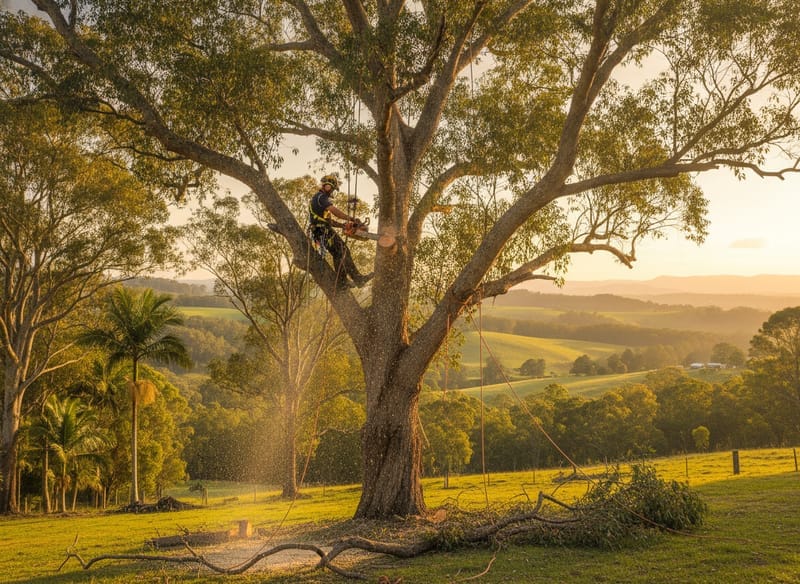
When wet, saturated ground in Thabeban prevents the use of elevating work platforms, our AQF Level 3 climbers utilize advanced rope access and double-rope techniques. We install friction devices to safely lower heavy, twisted limbs to the ground without damaging the structures below.
Storm-fallen trees are essentially loaded springs. Our operators hold advanced chainsaw and tree felling qualifications, allowing us to safely release tensioned wood. We process massive trunks using professional-grade ground saws to eliminate the risk of violent trunk kicks or rolls.
For large Hoop Pines or Flooded Gums that have collapsed onto homes or sheds, we utilise loader cranes and complex rigging systems. This allows our team to lift immense weight vertically off your roof, eliminating the risk of further collapse during the dismantling process.
Storms leave enormous volumes of leafy debris and shattered branches. We deploy high-capacity 12-inch wood chippers and mini-loaders to rapidly process fallen limbs into mulch on-site, clearing your driveway and yard efficiently so you can begin property repairs.
When disaster strikes in Thabeban, our response is structured to provide rapid relief and crystal-clear communication. It starts with an urgent on-site assessment. We walk your property to triage the damage, prioritizing trees that pose an immediate risk to life, housing, or access ways. We never guess; every hazard is methodically evaluated. Next, we provide a detailed, itemised quote. Because storm work is frequently an insurance matter, our team ensures every line item, photographic evidence of the hazard, and structural assessment is formatted perfectly for direct submission to your insurer. Once approved, our crews arrive fully equipped. We commence the make-safe phase, removing precariously hanging limbs and securing fallen trunks to prevent further movement. After the immediate danger is neutralised, we systematically dismantle the remaining damaged trees. Using modern rigging, lowering lines, and heavy-duty chainsaws, we process the timber safely to the ground. Finally, our skid steers and high-capacity chippers clear the debris, taking away the shattered limbs and leaving your Thabeban property clean, safe, and ready for recovery.
Post-storm tree work requires absolute certainty in safety and compliance. Our team operates under strict adherence to AS4373 for all canopy work and AS4970 for the protection of retained trees during heavy machinery access. Every climber holds an AQF Level 3 in Arboriculture, while our senior consulting arborist holds an AQF Level 5, allowing us to provide authoritative structural assessments for insurance claims. We carry comprehensive public liability and WorkCover insurance, ensuring that you, your property, and our staff are fully protected. Whether you are dealing with a shattered backyard Mango tree or complex roadside hazards requiring formal traffic management, we deliver professional, compliant results.
Thabeban’s mix of post-war brick homes and large backyard trees makes it particularly susceptible to summer storm damage. Saturated soils on the Burnett flood plain frequently lead to root plate failures in large shade trees like Poincianas and Jacarandas. When clearing storm damage, local regulations matter. While standard backyard trees usually do not require a permit, properties mapped under the Bundaberg Regional Council's Biodiversity areas overlay code or Bushfire hazard overlay may require formal assessment. Crucially, following the March 2026 Burnett River flood, a state disaster clearing exemption is currently active until March 2027 for the Bundaberg Regional Council area. This allows landholders to clear trees necessary to prevent property damage or maintain infrastructure. Our AQF Level 5 arborists can guide you through these local exemptions, ensuring you keep the right photographic records and written justifications while we safely clear your property.
Once the emergency removal is complete, it is vital to monitor the remaining trees on your property. Storm winds can cause micro-fractures in branches that may not fail but will pose a severe risk in the next heavy blow. We strongly recommend having our arborists return for a comprehensive health and safety check of your retained canopy ahead of the next wet season. If you plan to replant after losing a major shade tree, consider species resilient to Bundaberg’s coastal winds and heavy summer rains. Ensure any fresh mulch from the chipped debris is spread appropriately to aid soil moisture retention without suffocating the root collars of surviving trees.
Storm damage cleanup pricing in Thabeban reflects the scale of debris, tree sizes, and physical complexity.
We provide honest, itemised written quotes detailing all labour and machinery costs.
We provide storm damage tree removal throughout Thabeban and nearby suburbs.
Contact our local arborist crew for thorough storm cleanup and insurance documentation.
Get a Free Quote