Smooth Council Approvals
Submit compliant arboricultural reports that satisfy Bundaberg Regional Council planning conditions.
Authoritative AQF Level 5 arborist reports for development applications, hazard assessments, and council requirements.
Servicing Svensson Heights, Norville, Millbank, and all Bundaberg districts.
When you need formal tree documentation for a development application, neighbour dispute, insurance claim, or council overlay review, our arborist report Svensson Heights service delivers detailed, professional assessments.
While Svensson Heights is predominantly established residential land, nearby overlays or larger redevelopment sites subject to the Bundaberg Regional Council Planning Scheme 2015 require formal AQF Level 5 reports to justify tree retention or removal.
Submit compliant arboricultural reports that satisfy Bundaberg Regional Council planning conditions.
Know the exact health, life expectancy, and structural defects of significant trees before buying or building.
Back your insurance claims or property management decisions with defensible arborist evidence.
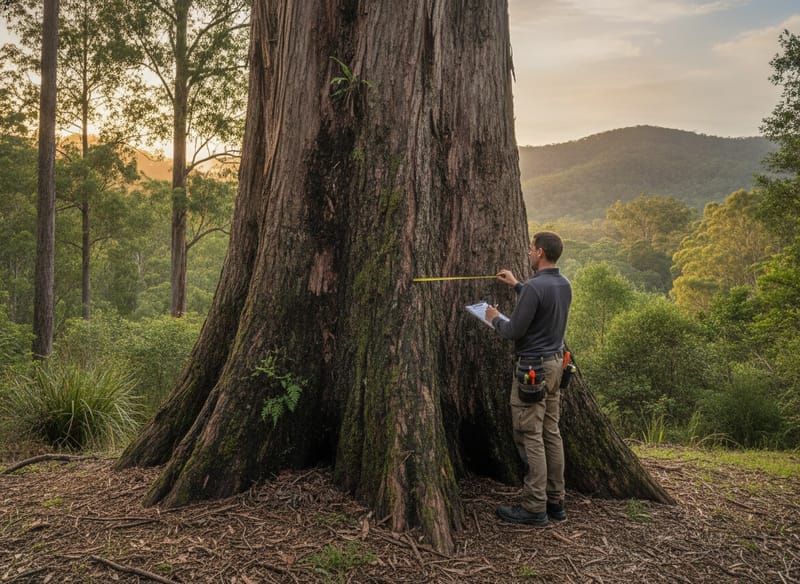
We inspect the tree, measuring trunk diameter, canopy spread, defect zones, and soil conditions.
We evaluate internal decay, fungal presence, root plate stability, and structural loading.
Our AQF Level 5 arborist compiles the findings, TPZ calculations, and formal recommendations.
We provide a comprehensive digital report ready for submission to council, certifiers, or insurers.
If you are planning a development, subdividing a block, or managing a potentially hazardous tree on your property, securing an accurate Arborist Report Svensson Heights is your critical first step. In this established part of Bundaberg, mature backyard trees and shifting council regulations mean property owners cannot afford guesswork when it comes to tree management.
Our team of qualified consulting arborists provides comprehensive, site-specific reporting tailored to the Bundaberg region. Whether you are dealing with a towering Hoop Pine that requires a risk assessment after a fierce subtropical storm, or you need a formal Tree Protection Plan to satisfy the Bundaberg Regional Council for a new build, we deliver the documentation you need.
We understand the local landscape, the impact of our wet summer storm seasons, and the specific planning instruments that govern vegetation here. From initial site inspection to handing over a detailed, council-ready PDF, our arborists ensure your project moves forward smoothly, legally, and safely.
One of the most common issues homeowners and developers face in Svensson Heights is having their Development Applications (DA) delayed or rejected because they submitted inadequate tree documentation. Relying on a standard tree lopper or a brief, unqualified letter to justify tree removal will almost certainly be knocked back by council. When building near mature vegetation, the Bundaberg Regional Council requires detailed, scientific assessments that meet strict Australian Standards.
Without an AQF Level 5 consulting arborist assessing your site, you risk misidentifying species, incorrectly calculating structural root zones, or running afoul of the Biodiversity areas overlay code. This can lead to thousands of dollars in project delays, redesign costs, or even heavy fines under the Vegetation Management Act 1999 if protected trees are unlawfully damaged.
The solution is to commission a professional Arborist Report Svensson Heights from our experienced team. We bring genuine arboricultural science to your property. We conduct thorough Visual Tree Assessments (VTA), accurately map Tree Protection Zones (TPZ), and provide clear, defensible retention or removal recommendations. By submitting a robust, AS4970-compliant report, you eliminate the guesswork, satisfy council requirements the first time, and protect yourself from future liability.
As qualified consulting arborists, we produce a range of highly technical, legally recognised documents to address every aspect of tree management, risk, and development compliance.
Required by council when construction or earthworks occur near existing trees. We provide a complete tree inventory, species identification, Trunk Diameter at Breast Height (DBH) measurements, and a Safe Useful Life Expectancy (SULE) rating. This report outlines clear retention and removal recommendations to guide your architects and builders.
Essential for safeguarding retained trees during the construction phase. We calculate and map exact Tree Protection Zones (TPZ) and Structural Root Zones (SRZ). The report details mandatory fencing, root mapping requirements, mulch protection, and specifies supervised work zones where machinery must be excluded.
Utilising Visual Tree Assessment (VTA) principles, we evaluate hazardous or declining trees—such as massive aging Mangos or storm-damaged Moreton Bay Figs. We document visible defects, assess target zones (like houses or footpaths), and rate the likelihood and consequence of structural failure to inform your duty of care.
When a tree falls under a council overlay but poses an unacceptable risk or is irrecoverably diseased, we compile a formal removal justification. This document details the tree's poor condition, the structural flaws driving the risk, and provides replanting recommendations to satisfy council environmental requirements.
Following extreme weather events, high winds, or our heavy summer rains, trees can fail and cause significant property damage. We provide expert causation analysis for insurance claims and legal disputes, documenting exactly why the failure occurred and assessing the remaining vegetation for hidden post-storm hazards.
Our consulting process is structured to be thorough, accurate, and completely transparent from the moment you contact us until you submit your documents to council. First, we conduct a detailed initial consultation over the phone. We discuss your specific goals—whether you are lodging a DA for a subdivision, dealing with an insurance claim, or worried about a leaning Queensland Blue Gum near your roofline. We then cross-reference your property against the Bundaberg Regional Council Planning Scheme 2015 to identify any immediate overlay triggers. Next, our AQF Level 5 arborist visits your Svensson Heights property. We conduct a hands-on assessment, taking precise DBH measurements, evaluating canopy health, sounding trunks for decay, and mapping the location of the trees relative to your existing or proposed structures. For DA reports, we calculate the required Tree Protection Zones on the spot. Finally, we return to the office to draft your comprehensive PDF report. We compile all field data, integrate high-resolution site photography, and outline clear, actionable recommendations. Once the report is delivered, our team remains available to answer questions from your certifier, builder, or the local council, ensuring your project proceeds without technical hitches.
Every Arborist Report Svensson Heights residents commission from us is authored by an in-house AQF Level 5 (Diploma of Arboriculture) consulting arborist. This is the minimum standard accepted by the Bundaberg Regional Council for formal tree documentation.
We base all our retention and protection reporting strictly on AS4970 Protection of Trees on Development Sites, ensuring your construction methods comply with national best practice. When pruning recommendations are made, they adhere to AS4373 Pruning of Amenity Trees, completely eliminating harmful practices like tree lopping or topping. Furthermore, our consulting services are backed by comprehensive Professional Indemnity and Public Liability insurance, granting you absolute peace of mind.
Svensson Heights is characterised by its relatively flat terrain, post-war brick homes, and highly established residential canopy. It is common to find massive backyard Mangos, sprawling Poincianas, and tall Jacarandas that have been growing for decades. Because the blocks here often have narrow side access, managing these large trees requires careful planning and robust documentation before any physical work begins.
While Bundaberg has no blanket tree preservation order on private land, council rules still heavily influence what you can and cannot do. If your Svensson Heights property intersects with the Biodiversity areas overlay code or is close to heritage character zones, council will demand a formal report before approving removals.
We also factor in our local subtropical climate. The wet summers and extreme weather events—like the remnants of ex-tropical cyclones that frequently impact Bundaberg—soften the ground and increase wind-shear risks. Our reports account for these local hazard drivers, ensuring your retained trees are genuinely safe for the long term.
Once we hand over your finalised PDF report, you are ready to submit it to your town planner, builder, or directly to the Bundaberg Regional Council.
If your report includes a Tree Protection Plan (AS4970), it is vital that your contractors install the specified protective fencing and mulch layers before any earthworks or machinery enter the site. The structural root zones must remain completely undisturbed.
If the report justifies tree removals or remedial pruning, you can seamlessly transition to the next phase. You can book our AQF Level 3 climbing and removal team to execute the physical work safely, knowing every cut will align with the approved recommendations and local council conditions.
Arborist reports in Svensson Heights are priced according to the scope of reporting, number of trees, and complexity.
We provide clear, upfront quotes based on the specific reporting requirements of your project.
We provide AQF Level 5 consulting arborist reports across Svensson Heights and all Bundaberg suburbs.
Speak with an AQF Level 5 consulting arborist for council-ready reports.
Request a Quote